
Every .ae domain moves through a predictable set of stages, from available to registered, then to expiration, redemption, and finally deletion back to the open pool. Understanding this lifecycle matters for two very different groups of people: owners who want to keep their domain, and domain investors who want to catch valuable names the moment they drop.
The .ae country-code top-level domain is operated by the .ae Domain Administration (.aeDA), part of TDRA. The lifecycle rules are based on global ccTLD best practices but have some UAE-specific details worth knowing, especially the daily drop window when deleted names come back onto the market.
This guide walks through each stage, explains what owners need to do at each point, and covers the growing .ae aftermarket where investors buy, flip, and resell premium names on platforms like Atom, Afternic, and Sedo.
The Four Stages of a .ae Domain Lifecycle
A .ae domain name moves through four clear stages. The image below, published by AEserver based on the official .aeDA policy, summarises the full cycle at a glance.
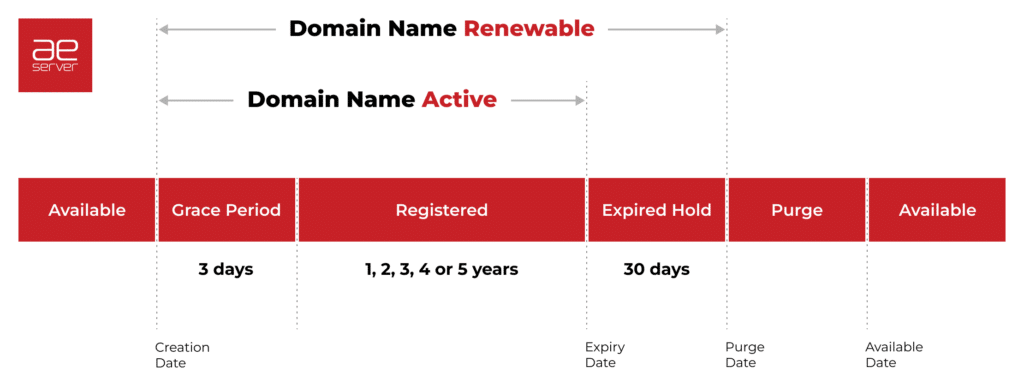
Official .ae domain name lifecycle chart.
Stage 1: Available
When a .ae name has never been registered, or after it has dropped back from deletion, it sits in the Available pool. Anyone globally can register it, there is no residency or local presence requirement for top-level .ae. Registration is on a first-come, first-served basis through an aeDA-accredited registrar.
Stage 2: Registered (Active)
Once registered, the domain is active for the period paid for, 1 to 5 years in annual increments. During this time the owner has full control: set DNS, build a website, use email, transfer between registrars, or sell the domain on the aftermarket. Renewal can be done any time during the active period.
Stage 3: Expired / Redemption Grace Period (30 Days)
If the owner does not renew before the expiration date, the domain enters a 30-day hold. During this window:
- The domain is removed from the DNS, websites and email stop working
- The current owner can still renew without any penalty fees
- The domain cannot be registered by anyone else during this period
- Transfer to a new registrar with simultaneous renewal is still possible
This is the “grace period” that exists precisely to protect owners from accidental loss. Most domains recovered in this window are ones where the owner forgot a credit card update or a renewal email went to spam.
Stage 4: Pending Delete / Drop (2 to 3 Days)
On day 31, if the domain has still not been renewed, it enters the Pending Delete phase. At this point:
- The previous owner can no longer recover it, standard renewal is closed
- The domain is queued for deletion by the registry
- Typically within 2 to 3 calendar days, the domain is purged from the registry and returned to the Available pool
- Once dropped, it becomes registrable by anyone, first come, first served
This is the stage where domain investors and backorder services enter the game.
When Do .ae Domains Drop? The Daily Release Window
One detail that is not obvious from the lifecycle chart alone is the actual time-of-day when deleted .ae domains become available again. The .ae registry processes drops in a daily window, and knowing this window is the single most important piece of information for anyone trying to catch expiring names.
Practical implications of this schedule:
- Saturday drops are pooled: Names that would have dropped on Saturday are typically released on Sunday or the next working day instead, which sometimes makes Sunday mornings particularly busy.
- Time-zone mathematics: Investors outside the UAE often set alarms or automate their tools to align with the UAE release window, since what is a normal working hour in Dubai may be very early morning or late night elsewhere.
- First-second advantage: Manual registration is almost never fast enough on a competitive name. By the time you click “register” on a parked site, a professional drop-catcher has already submitted dozens of API attempts.
- Public visibility: You can track which names are dropping by monitoring the .aeDA WHOIS data through our WHOIS lookup tool or by watching drop lists published by aftermarket operators.
Backorder Services: How Pros Catch Expiring .ae Domains
Because the drop window is short and competitive, a healthy industry of backorder services and expired-domain catching has grown around the .ae space. A backorder is essentially a standing order: “the moment this specific .ae domain becomes available, try to register it on my behalf.” When you place a backorder, the service runs automated registration attempts inside the drop window on your behalf.
How the process actually works:
- Identify the target: An investor spots a valuable name that is about to expire, for example a short dictionary word, a three-letter combination, or a local business name whose owner lapsed.
- Place the backorder: The service is paid a fee upfront (usually a few hundred dirhams for a standard .ae backorder, more for high-interest names).
- Watch through the grace periods: The service monitors the domain through the 30-day expiration hold and the 2-3 day pending delete phase.
- Fire at the drop moment: When the registry releases the name in the daily drop window, the backorder service sends rapid EPP registration requests, often hundreds per second, trying to be the first to land.
- Handle competition: If multiple people backordered the same name with the same service, or if multiple services catch it, the name usually goes to private auction among the interested parties.
Backorder services work because they invest heavily in infrastructure that individual buyers cannot match: direct API connections to the registry, co-located servers close to .aeDA’s data centre in Dubai, and fine-tuned retry logic that maximises catch probability in the first milliseconds of availability.
The .ae Aftermarket Boom: Atom, Afternic, Sedo
What happens after a valuable .ae name is caught? In most cases it goes onto an aftermarket marketplace, where it is marketed to end-user buyers at a significant premium over the original registration cost. The three main platforms driving this market are:
| Marketplace | Best for | Typical use |
|---|---|---|
| Atom.com (formerly Squadhelp) | Brandable invented names with curated landing pages and logos | Startup-friendly names, AI-generated brands, .ai and .com aftermarket |
| Afternic (GoDaddy) | Maximum distribution across 100+ registrar storefronts | Single-word .com, regional ccTLDs including .ae via registrar networks |
| Sedo | International buyer reach, especially strong for European and Middle-East buyers | .ae aftermarket visibility, auction format, premium brokerage |
A successful flip cycle looks like this: an investor catches a name like horse.ae for standard registration cost, builds a “for sale” landing page, lists the name on Sedo and Afternic, and waits for an end-user buyer (often a UAE company in the relevant vertical) to make an offer. Public record sales include horse.ae at over AED 6 million and multiple six-figure .ae transactions tracked by NameBio.
Why This Matters for the Whole .ae Market
The emergence of an active aftermarket has been transformational for .ae as an asset class. A few years ago, .ae was almost exclusively a utility extension for UAE businesses. Now it is an investment category in its own right. The knock-on effects:
- Investors are promoting .ae publicly. Domain investment blogs, Twitter (X) accounts, and industry conferences like Domain Days Dubai actively discuss .ae sales and trends.
- Brokers have built UAE-focused practices. Several regional brokers now specialise in .ae aftermarket deals, bringing professional valuation and negotiation to the market.
- Transparent price discovery. Public sales data on NameBio, Sedo, and other trackers means a UAE business owner can check what comparable .ae names sold for, instead of guessing.
- Premium pricing across the board. Early .ae investors who registered two-letter and three-letter names years ago are reselling them at 50x to 100x the original cost, pulling up the ceiling for the whole category.
- More registrar competition. More aftermarket activity draws more accredited registrars into the .ae space, which improves service quality for end users.
The net result is a .ae market with genuine liquidity, real brokerage, and rising reference prices. For anyone considering selling a .ae name, this is a genuinely good environment. For anyone considering letting one expire, it is a great reason not to. Our guide on how to sell your domain name in Dubai covers the full process of listing on these marketplaces.
How to Make Sure You Do Not Lose Your .ae Domain
The drop ecosystem works because real owners forget to renew. If you own a .ae name you actually use, keeping it is significantly cheaper than trying to buy it back at aftermarket prices. A practical checklist:
- Enable auto-renew. Set it and check once a year that the card on file is still valid. The single most common cause of domain loss is an expired credit card silently failing auto-renewal.
- Register for the maximum 5-year term. Fewer renewal moments means fewer opportunities to miss one. Annual reminders still apply, but the risk window is smaller.
- Keep WHOIS contact details current. If the email on file bounces, you will not see expiration notices. Update email when staff leaves the company.
- Register the domain under the company, not an employee. A .ae registered to an employee’s personal account goes with that employee when they leave.
- Consolidate under one registrar. Scattered portfolios mean forgotten renewals. See our guide on managing multiple domain names.
- Monitor your own WHOIS record. A monthly check using our WHOIS lookup tool confirms the expiration date, registrant details, and renewal status.
Good to Know: Transferring a .ae Domain While Expired
Unlike some generic TLDs, .ae allows a specific recovery move: you can transfer a .ae domain while it is in the Expired (30-day hold) stage, as long as the transfer order includes a renewal payment. This means if your current registrar is unresponsive, slow to renew, or simply unavailable, you can still save the domain by transferring it to a different accredited registrar and renewing during the transfer.
The mechanics:
- Obtain the domain’s AuthInfo code from your current registrar (even expired, they must provide it).
- Start a transfer and renewal order at the new registrar before the 30-day grace period ends.
- The new registrar handles the transfer and renewal in a single operation, and the domain comes back online under new management.
Once the domain enters Pending Delete on day 31, this option closes. After that point, the only way back is to catch it on the drop or buy it from whoever catches it.
Frequently Misunderstood .ae Lifecycle Details
- “I can recover my domain any time in the 30 days after expiry.” True, but only through renewal (or transfer + renewal). You cannot wait until day 29 casually, registrars process in batches and a late attempt may not complete before the pending delete starts.
- “Pending Delete is fixed at exactly 3 days.” It varies, typically 2 to 3 days, sometimes longer if the registry has queued processing due to volume. Do not use this as a recovery window, it is not one.
- “The drop is random.” No, it runs in a predictable daily window during UAE working hours, every day except Saturday. Catchers plan around this schedule precisely.
- “Anyone with fast internet can catch a valuable drop manually.” Not really. Professional drop-catchers run co-located infrastructure with API-level access. Manual registration attempts on high-value names almost never succeed.
- “Backorders guarantee the catch.” No, they improve your chances but do not guarantee it, especially on high-competition names where multiple services are targeting the same drop.
AEserver’s Verdict
The .ae domain lifecycle is the operational clock behind every UAE brand’s digital identity. For owners, the takeaway is simple: auto-renew, accurate WHOIS, company registrant, and consolidation with one registrar will protect your domain essentially forever. For investors, the .ae aftermarket is now one of the most interesting ccTLD markets globally, with a genuine drop scene, active backorder services, and professional marketplaces driving rising reference prices.
Either way, knowing the daily release window, the 30-day grace period, and the 2-to-3 day pending delete timeline puts you ahead of most UAE domain owners. If you are buying a new name, use AEserver’s .ae domain registration. If you are hunting premium names, check our Premium Domains marketplace for curated aftermarket inventory, or talk to our UAE-based brokers for anything more complex.

More in FAQ