Your domain name is the single most visible element of your brand online. It goes on your business cards, on your Instagram bio, on your invoices, and on every piece of Google search result your customers ever see. Pick the right one, and it does quiet marketing work for you for years. Pick the wrong one, and you will either rebrand later or lose clicks every single day.
This guide walks you through how to choose a domain name with a focus on the UAE market, from the core naming principles to the strategic question most people get wrong: which extension to register. We also cover how local businesses in Dubai and across the Emirates are increasingly buying premium .ae domains instead of expensive .com alternatives, and why that shift makes sense.
Why Your Domain Name Matters More Than You Think
A domain is not just a web address. It is a trust signal, a memory hook, and a search engine relevance marker all at once. In a market as competitive as the UAE, where Dubai alone adds thousands of new businesses every month, your domain needs to do three things well: be easy to remember, be easy to type, and be instantly recognizable as belonging to your brand.
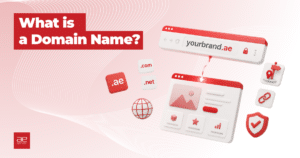
Before we get into naming strategies, it helps to be clear on what a domain actually is and how it connects to your hosting. If you want a quick refresher, we have a short explainer on what a domain name is and how it works.
Part 1: Core Principles of a Good Domain Name
Before you start searching for availability, get the fundamentals right. Every strong domain name, no matter the industry or country, shares the same set of qualities.
Keep It Short
Short domains win. They are easier to type on a mobile keyboard, easier to say out loud to a friend, easier to fit on a business card, and easier to remember a week later. Aim for under 15 characters total, and ideally 6 to 10. Anything longer and you start losing type-in traffic to misspellings.
Make It Easy to Pronounce and Spell
Say your shortlist out loud. If you have to spell it for someone on a phone call, it is too complicated. In the UAE, where your audience often switches between Arabic and English, this matters even more. A name that works cleanly in both languages, without odd consonant clusters or silent letters, will always outperform a clever but confusing one.
Avoid Hyphens and Numbers
Hyphens are the single most common cause of lost traffic. When someone hears your domain spoken out loud, they will almost never type the hyphen. Numbers create a similar problem, is it “4” or “four”? Skip both unless the number is a core, non-negotiable part of your brand identity.
Make It Brandable, Not Generic
A brandable domain like careem.com or noon.com is memorable precisely because it is unique. Generic keyword stuffing like best-cheap-dubai-shoes.com looks dated, ranks poorly, and screams low quality to both users and search engines. Modern SEO rewards brand signals, not exact-match keyword domains.
Check for Trademarks
Before you register anything, search the UAE Ministry of Economy trademark database and run a global check via WIPO Global Brand Database. Using a name that is already trademarked, even without knowing, can cost you the domain later through a UDRP complaint. Do the 10-minute check now rather than losing the domain in 18 months.
Part 2: Four Proven Strategies for Choosing Your Domain Name
There is no single “correct” way to arrive at a domain name. But after watching thousands of UAE businesses register domains over the years, we see four strategies that consistently produce strong results. Pick the one that matches your situation.
Strategy 1: Match Your Brand Name Exactly
This is the default and usually the best choice. If your company is called “Dune Logistics,” your domain should be dunelogistics.ae or dune.ae. The goal is zero friction between hearing your brand name and typing it into a browser.
The obvious problem: popular brand names are often taken on .com. This is where the UAE market has a structural advantage, the .ae namespace is far less crowded, and you can often secure your exact brand name on .ae even when the .com is gone. We will come back to this in Part 3.
Strategy 2: Pick a Beautiful, Memorable Word
If you are building a new brand from scratch, the best domains are often real words or invented words that sound pleasant. Think apple, noon, talabat, careem. These names work because they are easy to say, easy to spell, and distinctive enough to own in a market.
The trick here is to look for short, evocative words that have nothing to do with your product category. A dictionary word domain, especially on .ae, is a powerful brand asset that appreciates in value over time. Tools like our AI-powered domain name generator can help you brainstorm available options across hundreds of extensions at once.
Strategy 3: Use an Abbreviation or Acronym
Acronyms work especially well for B2B companies, professional services, and established institutions. Think adnoc.ae (Abu Dhabi National Oil Company), adib.ae (Abu Dhabi Islamic Bank), or dewa.gov.ae. A three or four-letter acronym is short, commanding, and premium-looking.
The challenge is that most three-letter .com domains have been taken for over a decade and sell for six figures. On .ae, three-letter and four-letter domains are still available in reasonable quantities, and even premium three-letter .ae names tend to cost a fraction of what an equivalent .com would cost.
Strategy 4: Buy an Aged Domain at Auction for SEO Speed
This is the advanced move, and it changes the economics of launching a new site in a competitive niche. Instead of registering a fresh domain and waiting 6 to 12 months for Google to start trusting you, you can buy a domain that already has age, backlinks, and existing domain authority.
The main ways to get one:
| Method | How It Works |
|---|---|
| Backorder | You place a reservation on a domain that is about to expire. When it drops, the drop-catch service tries to register it for you the instant it becomes available. If multiple people backorder the same name, it goes to a private auction. |
| Public Auction | Expired domains are listed on platforms like GoDaddy Auctions, NameJet, or Dynadot. You bid against other buyers. Prices range from AED 45 to tens of thousands depending on the domain’s metrics. |
| Aftermarket Marketplace | Platforms like Sedo, Afternic, or Dan.com list domains that current owners are actively selling. You negotiate or pay the asking price. Best for premium brandable names. |
An aged domain with a clean backlink profile can skip the “Google sandbox” entirely and rank within weeks instead of months. That said, this strategy only works if you do your due diligence carefully, which we cover in Part 4. If you are thinking about the flip side of this market, our guide on how to sell a domain name explains how the auction and broker ecosystem actually works.
Part 3: Choosing the Right Extension for the UAE Market
Here is where most guides go wrong. They tell you “.com is king” and stop. That advice is outdated, especially if you are targeting customers in Dubai, Abu Dhabi, Sharjah, or anywhere else in the UAE.
.ae: The Default Choice for UAE Businesses
Local businesses in the UAE are increasingly choosing to buy a domain name with the .ae extension as their primary online identity, and the logic is strong. The .ae extension is regulated by the UAE’s TDRA (Telecommunications and Digital Government Regulatory Authority), which gives it instant credibility with local customers. When someone in Dubai sees a .ae domain in search results, they know immediately that they are dealing with a business that operates in their country.
The benefits stack up:
| Benefit | Why It Matters |
|---|---|
| Local SEO boost | Google treats .ae as a geographic signal. For UAE-targeted searches, .ae sites get a ranking edge over generic .com sites, with no manual geo-targeting setup required. |
| Higher click-through rates | Local users recognize .ae as “theirs” and are more likely to click your result in search results than a generic .com. |
| Growing consumer trust | Consumer trust in .ae domains has grown year-over-year as more major UAE brands (ADNOC, ADIB, Emirates NBD) lead with .ae addresses. |
| Far better availability | The .ae namespace is much less crowded than .com. Short, brandable names that would cost AED 180,000+ on .com are still registerable on .ae for standard pricing. |
The proof is in the logos you already see every day across the UAE. Abu Dhabi Islamic Bank runs on adib.ae, ADNOC on adnoc.ae, Emirates NBD on emiratesnbd.ae, and Careem on careem.ae. These are not small players hedging their bets, they are the region’s most recognizable brands choosing .ae as a primary or strong parallel address. Your potential customers have been clicking on .ae domains from trusted household names for years, which means your own .ae domain inherits a baseline of credibility the moment it goes live.
Premium .ae Domains: The Quiet Advantage
This is where smart UAE businesses are making a move that international companies often miss. Premium .ae domain names, the short, dictionary-word, or category-defining names, are dramatically cheaper than their .com equivalents. A three-letter .com premium can easily run AED 180,000 to AED 1.8 million. A comparable three-letter .ae often sells for a fraction of that, sometimes a tenth.
And these are not obscure niche names. High-profile .ae sales have included horse.ae at AED 5.87 million, auto.ae at AED 370,000, and tv.ae at AED 349,000. For most UAE-focused businesses, securing a premium two or three-word .ae domain is the single highest-ROI branding investment they can make in year one.
The reason the pricing gap exists is historical. The .com market has been speculated on for 30 years, while the .ae aftermarket has only matured in the last decade. That gap is closing every year as more regional investors wake up to the opportunity, so premium .ae names are almost certainly more expensive next year than they are today.
.com: Still Valid for Global Brands
There are still good reasons to go with a .com domain. If your business is genuinely international and the UAE is just one market among many, or if you are a global SaaS, fintech, or e-commerce brand selling into dozens of countries, .com remains the universal default. Nearly half of all websites use it, and users worldwide still trust it as the “safe” choice.
The catch is availability. Finding a short, memorable .com that is not already registered and not priced at AED 75,000+ is genuinely difficult. Many new brands end up with awkward compromises: hyphens, added words, misspellings. When your “best available” .com starts looking like get-yourbrand-now.com, a clean yourbrand.ae is the better choice every time.
.me: The “Middle East” Myth
You will see UAE businesses using .me domains, often with the assumption that “ME” stands for Middle East. Technically, .me is the country code for Montenegro, a small European country. The Middle East association is a marketing story that .me’s registry has actively promoted, and global brands like KFC, Pizza Hut, and Vogue Arabia do use .me domains for their regional presence.
Here is our honest take: .me is fine as a secondary or personal-branding domain, but it is not quite the right choice as your main business domain in the UAE. It does not get the geographic SEO boost that .ae does for UAE searches, and local users are still more likely to recognize .ae as the truly local signal. If you have to pick one, pick .ae.
Avoid Novelty gTLDs Like .tech, .coffee, .store, .online
This is the single most important extension advice in this guide. The 2012 ICANN expansion unleashed hundreds of new generic TLDs, including category-specific ones like .tech, .coffee, .shop, .finance, .store, and so on. On paper they look clever. In practice, they consistently underperform in three ways.
First, they rank poorly. Google has publicly said it treats all gTLDs equally, but SEO practitioners have observed over a decade that novelty gTLDs struggle to build trust signals. A large part of this is behavioral: fewer people link to them, fewer people click them in search results, and many of these extensions have been associated with spam networks that further damage their reputation.
Second, user trust is low. Most UAE consumers still instinctively associate .com, .ae, .org, and .net with legitimate businesses. When they see an unfamiliar extension in search results or on a billboard, hesitation creeps in, and click-through rates suffer.
Third, many of them are tied to spam. Extensions like .xyz, .top, .click, .biz, and similar cheap gTLDs have been so heavily abused by spammers that email providers and security tools flag them automatically. Even if you build a legitimate business on one, you inherit the reputation of the neighborhood.
If you are curious about other Gulf region extensions and how they compare, we have a full breakdown in our guide to domain extensions across Gulf countries.
Part 4: How to Safely Buy an Aged Domain at Auction
If you are going the auction route for SEO acceleration, the due diligence process is the difference between a goldmine and a penalty. A domain with a spammy history can actively hurt your rankings even after you clean it up. Here is the checklist we run before bidding on any aged domain.
Check the Wayback Machine for History
Go to web.archive.org and type in the domain. Browse through multiple snapshots from different years. You are looking for two things: what the site was actually used for, and whether the topic stayed consistent.
Red flags: adult content, gambling sites, pharmacy spam, pages in languages the domain has no business being in, or the site repeatedly changing industries (business site → Japanese porn → casino → parked page is a classic pattern of a domain that has been resold multiple times for spam).
Check Backlinks in Ahrefs or Majestic
Run the domain through Ahrefs Backlink Checker (free version works for a quick scan). What you want to see: a decent number of referring domains (30+ is okay, 100+ is strong), a natural growth curve over years, and links from recognizable sites in a relevant niche.
Red flags include huge spikes in backlinks over a short period (a sign of a link-building spam campaign or negative SEO attack), backlinks from domains in completely unrelated languages or niches, anchor text dominated by commercial keywords like “buy cheap viagra,” “best online casino,” or “weight loss pills,” and a high Majestic Trust Flow to Citation Flow ratio gap (TF much lower than CF indicates low-quality links).
If you are new to these metrics, our guide on how to check domain authority walks through each one step by step.
Run a Google Index Check
Search site:yourdomain.com in Google. If Google returns zero results for a domain that was clearly active recently, it has been deindexed, which is a sign of a manual penalty. Walk away. Recovering a deindexed domain is technically possible but requires months of cleanup work and a reconsideration request.
Verify WHOIS History and Current Status
Use a WHOIS lookup tool to see the current ownership, expiration date, and status flags. For more depth, a service like DomainTools shows the full ownership history, how many times the domain has changed hands, and whether WHOIS records have been frequently modified, all signals of stability or instability. Our guide on how to find a domain name owner covers this process.
Check Against Blacklists
Run the domain through Google Safe Browsing, VirusTotal, and Spamhaus. If any of them flag it for malware, phishing, or spam distribution, do not buy. Getting off a blacklist often requires the same proof of ownership and remediation that recovering a penalty does, and many blacklists never fully clear historical entries.
Part 5: Our Advice in One Sentence
If we had to compress everything in this guide into one recommendation for a UAE business, it would be this: pick a short, pronounceable, brand-focused name on .ae (premium if budget allows), verify it has no trademark conflicts and no messy history, and register it for multiple years with auto-renew enabled. That single decision will pay back for the life of your business.
To take action now, you can start a live search across .ae, .com, and other relevant extensions directly on our domain registration page. Most of the names we’ve described in this guide can be checked and secured in under five minutes.
Summary: Mistakes to Avoid
- Choosing a long or complicated name, if you have to spell it out over the phone, it will lose traffic forever. Go short and simple.
- Using hyphens or numbers, people forget them when typing and you send customers to the wrong site or to a competitor’s site.
- Defaulting to .com without checking .ae, for a UAE business, .ae almost always delivers better local SEO, better CTR, and a shorter, cleaner name for less money.
- Picking a novelty extension like .tech, .coffee, .store, or .xyz, these consistently underperform on rankings, user trust, and email deliverability. Stick to .ae, .com, .org, or .net.
- Buying an aged domain without checking its history, a spammy Wayback history or toxic backlink profile will carry over and actively hurt your new site’s rankings.
- Skipping the trademark search, building a brand on a name that belongs to someone else is a ticking clock. The UDRP process can take the domain away, no matter how long you have held it.
- Forgetting to auto-renew, domain theft by letting registrations lapse is the most avoidable and most heartbreaking way to lose a domain. Enable auto-renew the moment you register.
- Registering in an employee’s personal name, the domain is a business asset and should be registered under the company’s legal name, with administrative access held by the founder or a trusted executive.
A domain name is one of those decisions where the cost of getting it right is small and the cost of getting it wrong compounds for years. Take the extra hour today, run the checks, and pick a name you will still be proud of in a decade.
More in Domains