
Every website on the internet, from a small personal blog to carrefouruae.com or noon.com, lives on a web hosting server somewhere in the world. Web hosting is the foundation of your online presence, and where that foundation sits (Dubai, Frankfurt, or Virginia) directly affects how fast your site loads, how much it costs, and how your business complies with UAE regulations.
This guide explains exactly what web hosting is, how it works, the different types available, and, crucially for UAE businesses, why choosing a locally-hosted server in the Emirates almost always beats using a generic international provider.
- Web hosting is the service of storing your website’s files on a server and delivering them to visitors’ browsers.
- You need both a domain name (address) and hosting (physical space) to run a website.
- The main types are shared, VPS, cloud, dedicated, managed WordPress, reseller, and colocation hosting.
- UAE-based hosting gives visitors in the Emirates ping times of 5 to 15 milliseconds, compared to 100+ ms from Europe and 200+ ms from the US.
- UAE hosting costs more than US or Indian hosting because of higher bandwidth, infrastructure, and compliance costs, but it pays back in speed, trust, and data residency.
- AEserver is a UAE-based professional hosting company focused on local infrastructure, Arabic and English support, and deep knowledge of UAE regulations.
1. What is Web Hosting? (Simple Explanation)
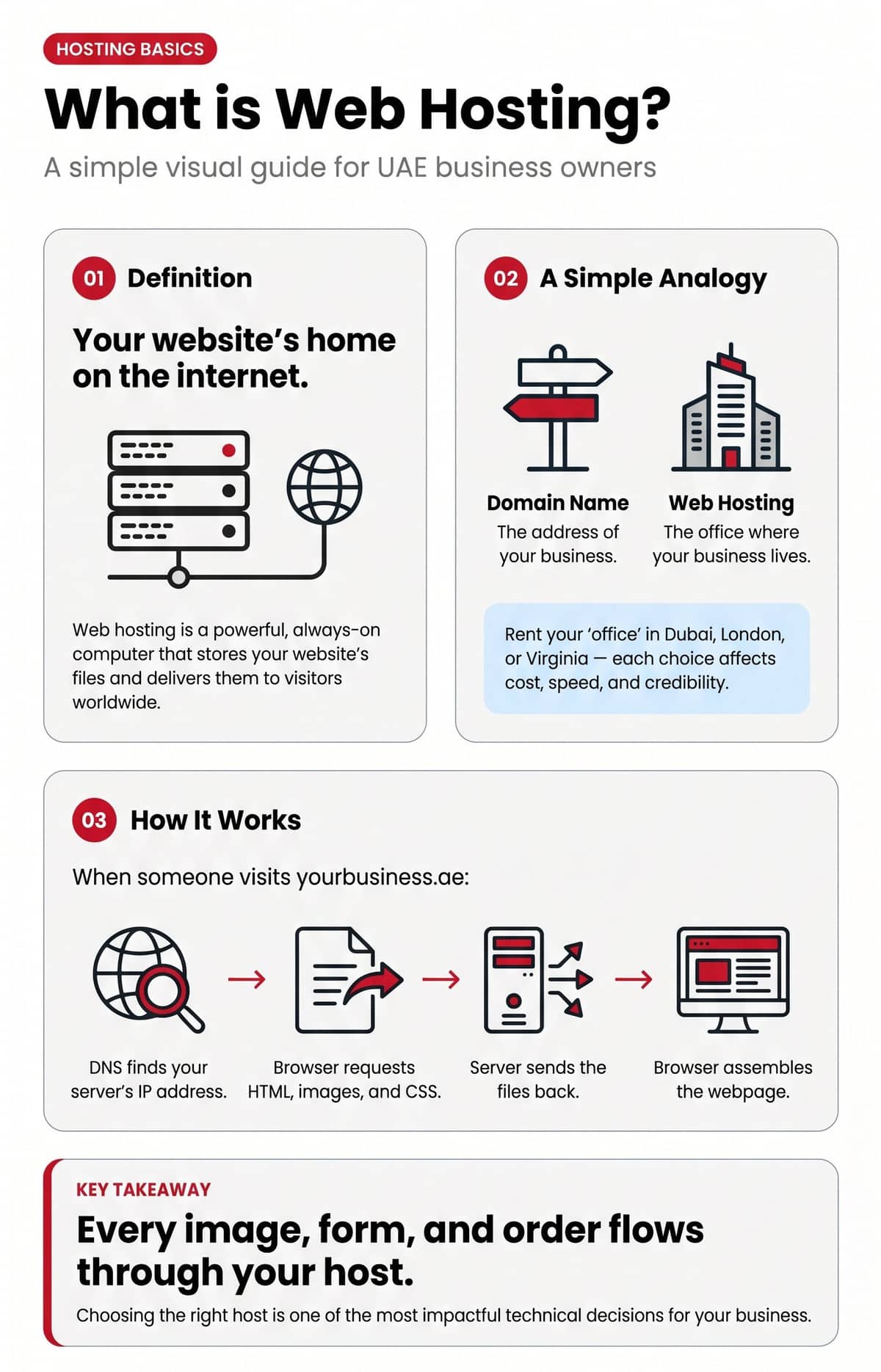
Web hosting is the service of renting space on a powerful, always-on computer (called a server) that stores your website’s files and makes them available to anyone who types your domain into a browser. Without hosting, your website would have nowhere to live and no way to reach visitors.
Think of it this way. If a domain name is the address of your business, then web hosting is the actual physical office space. You can rent that office in Dubai Internet City, in a shared building in London, or in a massive server farm in Virginia. Each choice has trade-offs in cost, speed, and credibility, and the same logic applies to web hosting.
In simple terms, when someone visits yourbusiness.ae:
- Their browser finds the IP address of your hosting server through DNS.
- The browser requests your website’s files (HTML, images, videos, CSS).
- The hosting server sends those files back.
- The browser assembles them into the page the visitor sees.
Everything that happens on your website, every image loaded, every form submitted, every order placed, flows through your hosting server. That’s why choosing the right host is one of the most impactful technical decisions you’ll make for your business.
2. How Web Hosting Works (Behind the Scenes)
A web hosting server is essentially a powerful computer optimised for one job: serving web content reliably, 24 hours a day, 365 days a year. It lives in a specialised building called a data center, with redundant power, cooling, internet connectivity, and physical security.
📋 The Journey of a Web Page Request
A visitor types your domain name
Someone in Abu Dhabi opens a browser and types yourbusiness.ae.
DNS translates the domain to an IP address
The Domain Name System looks up which server hosts your site and returns its IP address.
The browser connects to your hosting server
The connection travels across the internet from the visitor to the data center where your server lives. The shorter that physical path, the faster the connection.
The server processes the request
Your server runs the website’s code (PHP, Node.js, Python, etc.), often querying a database to fetch up-to-date content.
The server sends the response back
HTML, images, stylesheets, and scripts travel back along the same physical path to the visitor’s browser, which renders the complete page.
3. Types of Web Hosting
Not all hosting is created equal. Different businesses have different needs, and hosting providers offer a range of plans built around those needs. Here are the main categories.
📋 Shared Hosting
Your website shares a single physical server with dozens or hundreds of other websites. It’s the cheapest option and is perfect for new businesses, small blogs, brochure sites, and low-traffic projects. The downside is that a noisy neighbour (a site getting a traffic spike) can slow down everyone else on the same server.
Best for: Small business websites, startups, portfolios, personal blogs.
📋 VPS (Virtual Private Server) Hosting
A VPS gives you a guaranteed slice of a physical server, with dedicated CPU cores, RAM, and disk space that no one else can touch. You get much better performance and full control over the server environment without the cost of renting an entire machine. Explore cloud VPS hosting in the UAE for a deeper look.
Best for: Growing e-commerce stores, SaaS products, developer environments, medium-traffic sites.
📋 Cloud Hosting
Cloud hosting spreads your website across a cluster of connected servers. If one physical machine fails, others instantly take over. It also scales up automatically when traffic surges, making it ideal for unpredictable workloads. Modern cloud VPS plans combine the best of both worlds.
Best for: High-traffic websites, seasonal businesses (Ramadan sales, Black Friday), apps with variable demand.
📋 Dedicated Servers
You rent an entire physical server. No sharing, no virtualisation overhead, maximum performance and control. This is the premium option for businesses that need serious horsepower, custom configurations, or compliance-driven isolation. Browse dedicated servers in the UAE for enterprise workloads.
Best for: Large e-commerce platforms, financial applications, high-traffic media sites, custom enterprise systems.
📋 Managed WordPress Hosting
A specialised service built specifically for WordPress websites. The host handles updates, security, caching, and performance tuning, so you focus on content. If your site runs on WordPress, managed WordPress hosting in Dubai eliminates hours of ongoing maintenance work.
Best for: Any business running WordPress that doesn’t want to manage server-level details.
📋 Reseller Hosting
Designed for agencies, freelancers, and consultants who want to sell hosting to their own clients under their own brand. You get a bulk allocation of resources that you split across multiple customer accounts. Learn more about reseller hosting in the UAE.
Best for: Web agencies, design studios, IT consultants, freelance developers.
📋 Colocation
You own the physical server hardware, and the provider supplies the data center space, power, cooling, and internet connectivity. This is the ultimate in control and customisation, used by enterprises and technical organisations. See our colocation services in the Dubai data center.
Best for: Enterprises with existing hardware, telecoms, organisations with strict compliance requirements.
4. Local UAE Hosting vs International Hosting
This is the single most important decision most UAE businesses face when choosing a host, and it’s the one most often made badly. The global hosting market is dominated by US-based brands advertising extremely cheap plans. What those plans don’t advertise is that the actual servers are sitting in data centers thousands of kilometres away from your customers.
📋 What Local UAE Hosting Actually Means
Local hosting means the physical server is located in a data center inside the UAE, typically in Dubai. Every byte of your website is served from inside the country. When a visitor in Sharjah opens your site, the data travels maybe 50 kilometres across local internet infrastructure before reaching them.
With web hosting in the UAE, you also gain:
- Data residency: your business data never leaves the country.
- Regulatory alignment: easier compliance with UAE data protection laws, especially for finance, healthcare, and government-adjacent sectors.
- Local peering: direct connections to Etisalat, du, and UAE internet exchanges.
- Faster local DNS resolution.
📋 What International Hosting Means
International hosting means your server lives elsewhere: commonly the US (Virginia, Texas, Arizona), Europe (Frankfurt, London, Amsterdam), India (Mumbai, Delhi), or sometimes Singapore. You might pay less per month, but every visitor request has to travel thousands of kilometres across undersea cables and multiple network hops.
International hosting can make sense for certain use cases:
- Your target audience is global or concentrated in the hosting region.
- You’re running a very small, low-traffic site where ping differences are negligible.
- You need a specific service (a niche managed platform) only available abroad.
For UAE-first businesses, though, international hosting means slower pages, weaker local SEO, and more complicated compliance.
5. Ping, Latency and Site Speed: Why Server Location Matters
Here’s the most concrete way to understand why local hosting matters. Every connection to a server takes time, measured in milliseconds (ms). That time is called latency or ping, and it’s determined by physics: data can’t travel faster than light through fibre optic cables, and every kilometre adds measurable delay.
📋 Typical Ping Times from a UAE User
| Server Location | Approximate Ping from UAE |
|---|---|
| UAE (Dubai, Abu Dhabi) | 5 to 15 ms, excellent, feels instant |
| Saudi Arabia, Oman | 20 to 40 ms, very good |
| India (Mumbai) | 80 to 120 ms, noticeable |
| Europe (Frankfurt, London) | 100 to 140 ms, slight but real delay |
| Singapore | 130 to 170 ms, visible lag |
| US East (Virginia) | 180 to 220 ms, slow |
| US West (California) | 220 to 280 ms, very slow |
📋 Why 200 ms Feels Slow
A single ping measures one round trip. But loading a web page involves dozens or hundreds of requests. If each one adds 200 ms of travel time, the cumulative delay becomes obvious:
- 5 ms per request (UAE server): a typical page finishes loading in about 1 second.
- 120 ms per request (European server): the same page takes 2 to 4 seconds.
- 220 ms per request (US server): the same page takes 4 to 8 seconds or more.
Google’s own research shows that every additional second of page load time can reduce conversions by up to 20%. In e-commerce, speed is money. In SEO, speed is rankings. In customer experience, speed is trust.
📋 Local SEO Impact
Google considers server location as one of many signals when ranking local search results. A website hosted in the UAE, on a .ae domain, serving UAE customers, sends every possible geographic signal correctly. A UAE business on a US server loses a subtle but real advantage on google.ae search results.
6. Why Does UAE Hosting Cost More Than US or European Hosting?
A frequent question from business owners comparing quotes: why is UAE hosting typically more expensive per month than the cheap plans advertised by global brands? The answer is that UAE infrastructure genuinely costs more to operate, and you’re paying for real, measurable quality differences.
📋 Higher Bandwidth Costs
The UAE’s internet bandwidth market is dominated by two licensed telecom operators, Etisalat and du. Wholesale bandwidth in the UAE historically costs many times more per megabit than bandwidth in Amsterdam or Ashburn, Virginia, where dozens of tier-1 carriers compete. Every gigabyte your website sends to visitors costs the hosting company more in the UAE than it would abroad.
📋 Data Center Infrastructure
Building and operating a data center in Dubai is expensive. Land, cooling (in a climate where outdoor temperatures hit 45°C), power, diesel backup, and 24/7 physical security all cost more than equivalents in cooler, more mature data center markets.
📋 Smaller Economy of Scale
US hyperscalers like AWS, Google Cloud, and the budget brands built on top of them operate millions of servers. The UAE hosting market, while growing rapidly, is smaller. Smaller scale means less aggressive pricing power.
📋 Local Support and Compliance
A UAE hosting company employs UAE-based support staff, complies with TDRA (Telecommunications and Digital Government Regulatory Authority) requirements, follows UAE data protection rules, and handles documentation in both Arabic and English. All of that costs more than running a support floor offshore.
7. AEserver vs Global Providers: GoDaddy, Hostinger, and the Rest
Let’s be direct. GoDaddy and Hostinger are legitimate, large, globally known hosting providers. They have tens of millions of customers, solid infrastructure, and aggressive pricing. Many UAE businesses sign up with them because the headline prices are cheap and the marketing is relentless.
For some users, those providers are perfectly adequate. For UAE-focused businesses, there are important differences that rarely make it into the marketing. Here’s an honest comparison.
📋 Server Location and Speed
GoDaddy and Hostinger operate data centers in the US, Europe, India, and Asia. None of their mainstream shared or WordPress hosting plans offer genuine UAE-based servers. Your site physically sits hundreds or thousands of kilometres from your UAE customers.
AEserver operates directly from UAE data centers, giving your visitors the 5 to 15 ms ping times shown earlier.
📋 Support and Language
Global providers run support centres offshore (commonly the Philippines, India, or Eastern Europe). You’ll reach someone competent, but they won’t understand UAE-specific context: TDRA regulations, UAE trade licenses, local payment gateways, or Arabic-language hosting needs. Tickets often bounce between shifts with limited continuity.
AEserver provides support from a UAE-based team that speaks Arabic and English, and that deals with UAE businesses every single day. If you have a question about connecting your .ae domain, setting up an Arabic-language WordPress site, or handling a TDRA notification, you’re talking to someone who already knows the answer.
📋 Billing and Currency
Global providers typically bill in USD or EUR. Your UAE credit card gets charged with foreign-transaction fees, and the final AED amount varies with exchange rates every renewal cycle. Invoices aren’t always structured for UAE accounting or VAT.
AEserver bills transparently in AED, with proper UAE-compliant VAT invoicing.
📋 Local Knowledge and Ecosystem
Global providers offer a generic, one-size-fits-all experience. They don’t know the difference between a Dubai mainland trade license and a free zone license, they don’t integrate with UAE-specific payment gateways out of the box, and they don’t have relationships with the Gulf region domain registries.
AEserver is built from the ground up for UAE and Gulf businesses. We’re a TDRA-accredited .aeDA registrar, we work daily with UAE trade licenses, and our entire focus is on professional local hosting and infrastructure: cloud VPS, dedicated servers, and colocation in Dubai.
📋 When Global Providers Might Be the Right Choice
To be fair: if you’re running a purely international business with no UAE audience, if you’re testing a personal project with almost no traffic, or if your monthly budget is strictly limited to a few dollars, a cheap global plan can be reasonable. What doesn’t make sense is running a UAE business, selling to UAE customers, and accepting 200 ms of added latency on every page load, with generic offshore support, just to save a few dirhams a month.
8. How to Choose the Right Hosting for Your UAE Business
Choosing hosting doesn’t need to be complicated if you match the plan to your actual use case.
📋 Decision Framework
- Small business website, brochure site, portfolio: UAE-based shared hosting is ideal. Affordable, fast locally, easy to manage.
- WordPress blog or content site: WordPress hosting, or managed WordPress hosting if you want zero maintenance overhead.
- Growing e-commerce store: cloud VPS hosting gives you the performance and scalability you’ll need as traffic grows.
- Enterprise application, heavy database, compliance requirements: dedicated server or colocation.
- Agency or freelancer managing multiple client sites: reseller hosting.
- Custom infrastructure, existing hardware, maximum control: colocation in a Dubai data center.
📋 Questions to Ask Before Buying
- Where are the servers physically located? (Ask for the city, not just the region.)
- What’s the guaranteed uptime SLA?
- Are backups included, and how often are they taken?
- Is a free SSL certificate included?
- Is support local, and what hours is it available?
- Is billing in AED, and does it include VAT?
- What happens if I need to upgrade to a bigger plan later?
9. Web Hosting vs Domain Name: What’s the Difference?
This is the most common confusion for first-time website owners. The two are related but completely separate services, and you almost always need both.
| Service | What It Does |
|---|---|
| Domain name | The human-readable address people type to reach your site (e.g. yourbusiness.ae). |
| Web hosting | The physical server space where your website files actually live. |
A domain without hosting is like a street address pointing to an empty lot. Hosting without a domain is like a fully-furnished office with no address, visitors can’t find it. The two connect through DNS settings: once you own a domain, you point it to the IP address of your hosting server, and visitors can reach your site.
For a full walkthrough of how domains work, see our separate guide: What is a Domain Name? Complete Guide for UAE.
10. Key Features to Look for in a Hosting Provider
Beyond price and server location, these are the technical details that separate professional hosting from cheap hosting.
📋 Uptime Guarantee
Look for 99.9% or higher. 99.9% uptime still means up to 8.7 hours of downtime per year, so “five nines” (99.999%) is the gold standard for mission-critical sites. Cheap shared hosts often don’t publish real uptime numbers.
📋 SSD or NVMe Storage
SSD is now the minimum acceptable storage type. NVMe is significantly faster and is standard on modern plans. Traditional spinning hard drives are a red flag in 2026.
📋 Automatic Backups
Daily or weekly automated backups, with easy one-click restore, are essential. If your provider doesn’t offer backups (or charges extra), consider that a significant drawback.
📋 SSL Certificate Included
Every modern website needs HTTPS. A good host includes a free SSL certificate (usually via Let’s Encrypt) or makes it trivial to install a paid SSL certificate. Read our SSL certificate FAQ for a deeper explanation.
📋 Email Hosting
Professional branded email (like info@yourbusiness.ae) is typically separate from web hosting but often bundled or easily added. Consider whether you need business email hosting or Microsoft 365 email at the same time.
📋 Control Panel
cPanel, Plesk, or a modern custom control panel should let you manage files, databases, email, and DNS without needing developer expertise.
📋 Scalability
Can you easily upgrade from shared to VPS to dedicated, without migrating to a completely different provider? A good host grows with you.
11. Common Web Hosting Mistakes to Avoid
After years of helping UAE businesses move between hosting providers, we see the same mistakes come up repeatedly.
- Choosing purely on headline price. A $1/month plan that’s slow, unreliable, and unsupported costs you much more in lost sales than you save in fees.
- Hosting a UAE business on a US server. You accept 200+ ms of latency, weaker local SEO, and foreign currency billing, all for savings that rarely justify the trade-off.
- Ignoring server location entirely. If the provider won’t tell you which city the server is in, that’s a warning sign.
- Not checking the renewal price. Introductory rates often double or triple on the second year. Always read the fine print.
- Skipping backups. Sites get hacked, files get corrupted, mistakes happen. Without backups, recovery is sometimes impossible.
- Overbuying. You don’t need a dedicated server for a 10-visit-a-day brochure site. Start with what fits your actual traffic.
- Underbuying. On the other hand, cramming a serious e-commerce store onto the cheapest shared plan guarantees slow pages and frustrated customers.
- Forgetting about support quality. You’ll need help eventually. The difference between great and terrible support shows up at 2 AM on a Saturday when your site is down.
- Locking into non-standard platforms. Proprietary “website builders” sometimes make migration painful or impossible. Standard tech (cPanel, WordPress, open databases) keeps you portable.
12. Frequently Asked Questions
📋 What is web hosting in simple terms?
Web hosting is a service that stores your website’s files on a powerful, always-on server so that anyone on the internet can visit your website. You rent space on that server, and the hosting company keeps it running around the clock.
📋 Do I need web hosting if I have a domain name?
Yes. A domain name is just the address of your website. To actually have a website that visitors can see, you also need web hosting, which is the physical storage space where your site’s files live. Without hosting, typing your domain into a browser leads to an error.
📋 How much does web hosting cost in the UAE?
Prices vary widely by type. Shared hosting in the UAE starts at affordable monthly rates in AED, VPS hosting is mid-range, and dedicated servers or colocation cost significantly more. UAE-based hosting generally costs more than the cheapest international plans because of local infrastructure costs, but the difference is usually worth it for UAE-focused businesses.
📋 Is UAE hosting really faster for local visitors?
Yes, meaningfully so. A UAE visitor loading a site hosted in Dubai experiences ping times of 5 to 15 milliseconds. The same visitor loading a site hosted in the US experiences 180 to 280 milliseconds. Across a page with dozens of requests, the cumulative difference can mean pages loading in 1 second versus 4 to 8 seconds.
📋 Is GoDaddy or Hostinger good for UAE websites?
They’re legitimate providers and work fine for some use cases. For UAE-focused businesses, however, they have no UAE-based servers, offshore support that doesn’t know local regulations, USD billing, and weaker local SEO performance. A UAE-based host like AEserver offers genuinely local infrastructure, local Arabic and English support, and AED billing.
📋 What’s the difference between shared hosting and VPS?
Shared hosting puts many websites on one server, which keeps costs low but means performance varies with what neighbours are doing. VPS hosting gives you guaranteed resources (CPU, RAM, disk) that no one else can use, with much better performance and more control, at a moderately higher price. For a deeper comparison, see our guide on how to choose between shared hosting and VPS.
📋 Can I move my website to a new host later?
Yes. You can migrate your website between hosts at any time. Most professional hosting providers will help with the migration, often for free. Using standard platforms like WordPress makes migration much easier than proprietary website builders.
📋 Do I need technical knowledge to use web hosting?
Not as much as you might think. Modern hosting comes with control panels (cPanel, Plesk) that handle most tasks through a visual interface. Managed hosting plans go further and handle server maintenance, updates, and optimisation for you. For more technical setups (VPS, dedicated servers), some sysadmin knowledge is helpful, or you can choose managed plans.
📋 What is cloud hosting, and is it better than traditional hosting?
Cloud hosting spreads your website across multiple connected servers, so if one fails, others take over automatically. It also scales up and down with demand. For sites with variable or high traffic, cloud hosting offers better reliability and flexibility than single-server hosting. For small, predictable sites, traditional shared or VPS hosting is often simpler and cheaper.
📋 Does server location really affect SEO?
Yes, though it’s one signal among many. Google’s algorithms consider server location, domain extension, language, and content when deciding local search rankings. A UAE business on a .ae domain hosted in the UAE sends every geographic signal correctly and tends to perform better on google.ae than an identical site hosted abroad on a .com domain.

More in Hosting