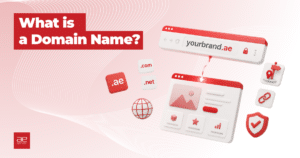
A domain name is the address people type to reach your website, and it is also one of the first signals your business sends online. Different types of domains serve different purposes: some carry global trust, some anchor your brand to a specific country, and some mark you as an e-commerce or tech player. This guide walks through every major domain type you need to know, from the basic TLD, SLD, and subdomain structure to ccTLDs, sTLDs, IDNs, premium and parked domains, and shows how to pick the one that fits your business.
Part 1: How a Domain Name Is Structured
Before exploring the types of domain names, it helps to understand how any web address is built. Every domain has two required parts and one optional part. Reading a domain from right to left, you move from the most general level to the most specific.
Take the address shop.yourbrand.com as a working example:
| Part | Value in example | What it means |
|---|---|---|
| Top-Level Domain (TLD) | .com | The extension at the end of the address. Managed by IANA and operated by a registry. |
| Second-Level Domain (SLD) | yourbrand | The unique name you register. This is where your brand sits. |
| Subdomain (Third-Level Domain) | shop | Optional prefix used to organize sections of a site, such as shop, blog, or support. |
Top-Level Domain (TLD)
The TLD is the final segment of the address, to the right of the last dot. It is the most strategic choice, because the TLD tells users and search engines a lot about your site before they click. The full list of TLDs currently delegated in the DNS root zone is maintained by IANA in the Root Zone Database, which holds over 1,500 entries.
Second-Level Domain (SLD)
The SLD is your unique name, the part you actually register and own. In aeserver.com the SLD is aeserver. When you choose a domain for your business, most of your time is spent finding the right SLD: short, brandable, easy to spell, and still available to register.
Subdomain / Third-Level Domain
A subdomain is a prefix added in front of your SLD that creates a logically separate section of your site without registering a new domain. Common examples are blog.yourbrand.com, shop.yourbrand.com, or support.yourbrand.com. Subdomains are free to create if you already own the main domain. The historical www prefix is technically a subdomain, although most modern websites no longer require it.
Part 2: Main Types of Top-Level Domains
Top-level domains are grouped into several official categories. Each group has its own rules, use cases, and audience. If you are choosing a domain for your business, you are almost always choosing between a generic TLD, a country-code TLD, or one of the newer gTLDs.
Generic Top-Level Domains (gTLDs)
Generic TLDs are not tied to any country. They are open to anyone, anywhere in the world. The classic gTLDs are the oldest and most widely recognized extensions online.
| Classic gTLD | Original purpose | Best use today |
|---|---|---|
| .com | Commercial entities | Default choice for almost any business worldwide |
| .net | Network providers | Tech and infrastructure brands, or a .com fallback |
| .org | Non-profit organizations | Non-profits, charities, open-source projects, communities |
| .info | Informational sites | Blogs, reference sites, educational resources |
| .biz | Business use | Alternative when the .com version is taken |
The .com extension remains the most recognized TLD in the world, and for most businesses it is still the safest default. You can check availability and register one through the AEserver .com registration page.
New gTLDs
Starting with the ICANN New gTLD Program, hundreds of new generic extensions became available, including descriptive strings such as .shop, .store, .tech, .app, .online, .site, .live, .club, and .xyz. These give brands more room to find a short, meaningful name when .com is taken, and they make the purpose of the site clear right in the address.
| New gTLD | Who typically uses it |
|---|---|
| .shop / .store | Online retailers and e-commerce brands |
| .app | Mobile and web application developers (HTTPS required) |
| .ai | Artificial intelligence companies, although technically it is the ccTLD of Anguilla |
| .online / .site / .xyz | Startups and general-purpose projects looking for short names |
| .club / .live | Communities, streamers, event and membership sites |
Country-Code Top-Level Domains (ccTLDs)
Country-code TLDs are two-letter extensions tied to a specific country or territory, defined by the ISO 3166-1 standard. A ccTLD is a strong signal that your business is present in, or focused on, that market. Local audiences tend to trust local extensions more, and search engines use ccTLDs as a ranking signal for geo-targeted results.
| ccTLD | Country or territory | Notes for business |
|---|---|---|
| .ae | United Arab Emirates | The national extension of the UAE, trusted across Gulf markets |
| .abudhabi | Emirate of Abu Dhabi | Geographic TLD for businesses anchored in Abu Dhabi |
| .qa | Qatar | Official ccTLD of Qatar, good fit for local presence |
| .bh | Bahrain | Official ccTLD of Bahrain, signals local commercial presence |
| .uk, .de, .jp | United Kingdom, Germany, Japan | The strongest local signal in each of these markets |
If your business is based in or targets the Gulf region, a local ccTLD is often a stronger choice than a generic .com. You can browse available regional extensions, including .ae, .abudhabi, .qa, and .bh, or register your .ae domain directly through AEserver.
Sponsored Top-Level Domains (sTLDs)
Sponsored TLDs are restricted extensions managed by a dedicated organization on behalf of a specific community. You cannot simply register an sTLD, you need to meet eligibility requirements defined by the sponsor.
| sTLD | Who it is for |
|---|---|
| .gov | United States government agencies |
| .edu | Accredited post-secondary educational institutions |
| .mil | United States military |
| .int | Organizations established by international treaty |
| .museum | Accredited museums |
| .aero, .coop, .travel | Aviation, cooperatives, and travel industry members |
For most commercial businesses, sTLDs are not an option. They are useful to know about because a site on .gov or .edu carries a very high trust signal, which affects how users and search engines perceive content from those sources.
Internationalized Domain Names (IDNs)
An internationalized domain name uses characters from non-Latin scripts such as Arabic, Chinese, Cyrillic, or Greek. IDNs make the web accessible to users in their native language, both in the SLD and in the TLD. Under the hood, IDNs are converted through a process called Punycode into an ASCII string starting with xn--, which is what the DNS actually uses to route traffic.
Part 3: Other Types of Domains You Should Know
Beyond the TLD categories, there are a few practical labels you will see when shopping for a domain. These are not separate technical types, they describe the status or commercial value of a domain.
Premium Domains
Premium domains are short, memorable, or keyword-rich names that are already registered and listed for resale, often at significantly higher prices than a standard registration. They can cost anywhere from a few hundred dollars to several million. The advantage is instant brand equity and strong SEO potential. The risk is paying for a name without fully checking its history and past use.
You can explore available options on the AEserver premium domains marketplace.
Branded Domains
A branded domain is simply a domain that matches your company or product name, usually on a .com or a local ccTLD. This is not a separate technical type, it is how most businesses approach registration in practice. The goal is simple: when someone remembers your brand, typing it into a browser should reach your site. Owning the exact-match branded domain also protects you from typosquatting and copycats.
Parked Domains
A parked domain is one that has been registered but is not yet in active use. Businesses park domains to reserve a future brand name, to hold a name before a launch, or to prevent competitors from registering similar variants. Parked domains often display a placeholder page with ads or a simple notice from the registrar.
Expired and Drop-Caught Domains
If a registrant does not renew their domain on time, it eventually drops and becomes available again. Domain investors monitor these drops and re-register valuable names quickly for resale. When buying an expired domain, always check its past use through a WHOIS lookup, review its backlink profile, and scan its reputation, because a domain previously used for spam or malware will carry that history into your brand.
Part 4: How to Choose the Right Domain Type for Your Business
The best domain type depends on who you serve, where you serve them, and how visible you want to be in that market. Use the table below as a quick decision framework.
| Business scenario | Recommended domain type |
|---|---|
| Global company, broad audience | .com as primary, plus matching ccTLDs in key markets |
| Business based in the UAE or the Gulf | .ae, .abudhabi, .qa, or .bh for local trust, plus .com for international reach |
| Online store or marketplace | .shop or .store if .com is taken, or brand.com with a /shop subdirectory |
| Tech startup or SaaS | .com, .io, .ai, .app, or .tech |
| AI or machine learning product | .ai, short, branded, and industry-specific |
| Non-profit or community project | .org for legacy trust, .community or .club for newer projects |
| Personal brand or portfolio | .me or firstnamelastname.com |
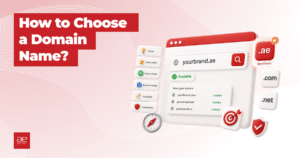
If you are still weighing options, the guide How to Choose a Domain Name walks through the decision step by step.
Part 5: Common Mistakes When Choosing a Domain Type
Most domain regrets come from a few repeatable mistakes. Avoid these, and you will land on a domain that still works five or ten years from now.
- Picking a ccTLD without checking eligibility, some country extensions require local presence, a trade license, or identity documents. Confirm the rules before you build a brand around the name.
- Grabbing a new gTLD that does not match your niche, a .shop for a consulting firm or .tech for a bakery confuses visitors and hurts click-through rates.
- Ignoring trademark conflicts, a domain that infringes on an existing trademark can be taken away through a UDRP dispute, regardless of who registered it first.
- Choosing a long, complex name, if users cannot type it correctly from memory, you lose direct traffic and word-of-mouth referrals.
- Using hyphens or numbers, they are hard to communicate verbally and feel unprofessional in email signatures or on business cards.
- Forgetting defensive registrations, a competitor can buy the .net, .co, or common misspellings of your .com and siphon off traffic that was meant for you.
- Skipping auto-renewal, an expired domain can be lost in hours and may be impossible to recover.
- Overpaying for a premium name before validating the business, invest in a high-value domain only when the brand and the product are already proven.
Summary
- Domains have three levels, the TLD on the right, the SLD you own in the middle, and an optional subdomain on the left.
- TLDs fall into four main groups, gTLDs like .com and .org, ccTLDs like .ae and .qa, sTLDs like .gov and .edu, and new gTLDs like .shop and .ai.
- ccTLDs signal local trust, pick .ae, .abudhabi, .qa, or .bh when you want to anchor your business in the Gulf region.
- New gTLDs work best when the word and the extension read as one phrase, like coffee.shop or maria.photography.
- Premium, parked, and expired are statuses, not technical types, each one carries its own risks and upsides.
- Start with one strong primary domain, then register defensive variants to protect your brand from competitors and squatters.
Once you have picked the right type, the next step is checking availability. Use the AEserver domain search or the AI domain search to find the exact name you want, or browse the full list of available TLDs at AEserver.

More in Domains